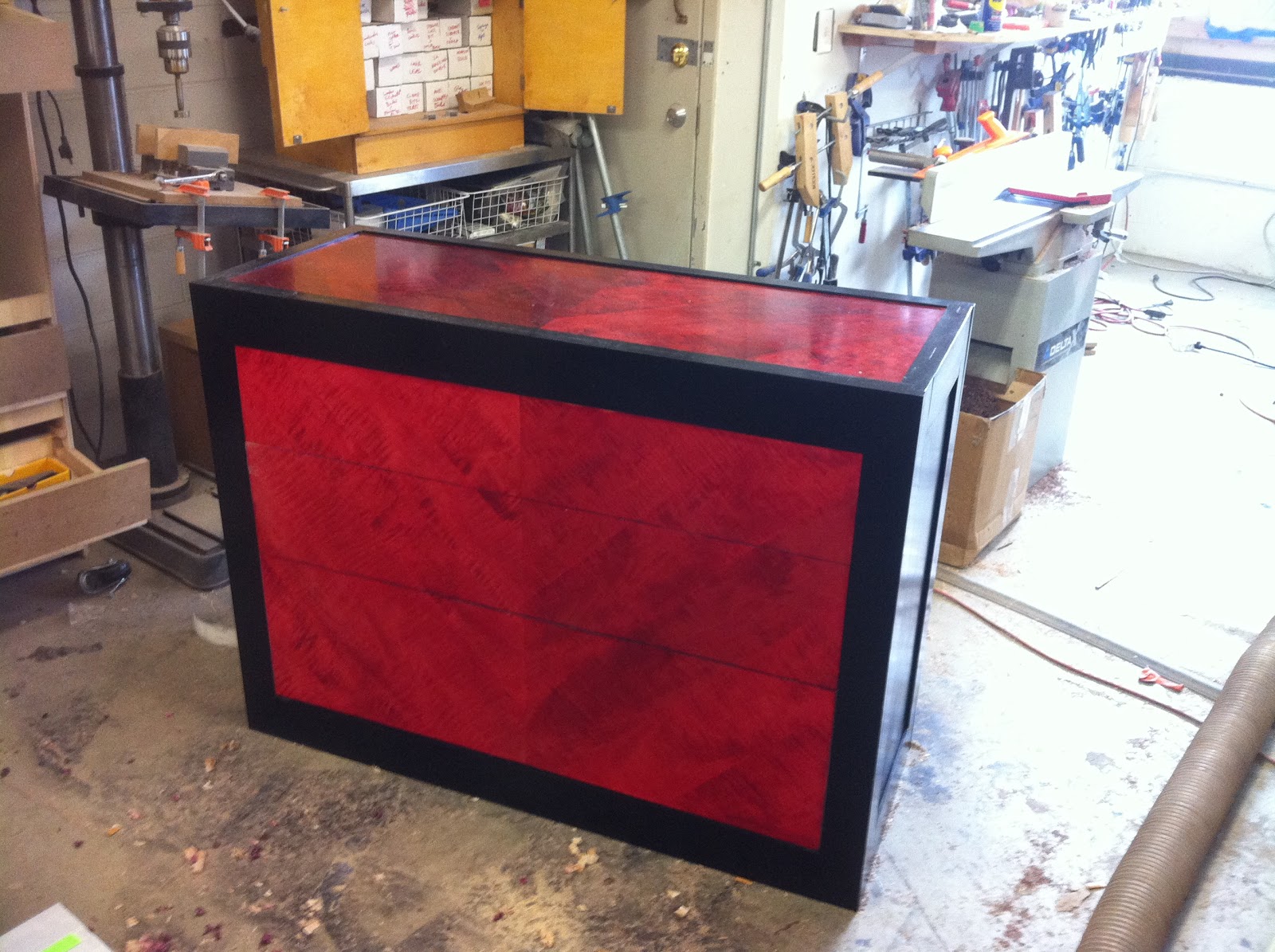
It's also my first experiment with using water-based dye in furniture. The case is actually a 90 gallon aquarium stand, which I cracked when driving a screw into dry birch. It's strong enough to be a dresser, so I fixed the crack and added some drawer runners inside. The drawers are made from sheets of scrap 1/4" plywood, scrap 3/4" birch & maple, and scrap 3/4" MDF. They're heavy but they work.
About the drawer fronts: from ugly to sexy
 The drawer faces and top are made from scrap curly maple. This lumber was NOT premium by any stretch: the boards were thin, pitted, narrow, and covered with the unsightly "brown hearts" that furniture makers avoid. Because of the brown hearts, I knew I would need to color the drawer fronts and top somehow, and I didn't want to use stain, which dulls curly maple.
 Because the boards were so narrow, I wouldn't be able to use a single board for each drawer. And because the "curls" were so spotty, it would be impossible to make two boards look like a single board. To get around these visual problems, I decided to form a "V" shaped panel, with each board angling toward the center line at 45 degrees.
Once I had made my V shaped panels, it was a natural choice to use red and burgundy dye to bring out the wavy figure of the curly maple, and bring a bit of visual consistency to the mish-mash of light and dark grain.
I sized the drawer fronts so each drawer was taller than the next by a ratio of 1:1.618 - the golden ratio. Then I cut the drawer front panel into three strips of the appropriate size.
The handles: routed from a scrap VG Fir 2x4
 I like using VG fir for the moldings on large aquarium stands. Hence, I have some scraps of VG Fir 2x4. VG Fir is knot-free and easily milled, and well cured, unlike fir studs. to size the handles, I divided the width of the dresser by 10 to get a length for the small handle of 4.8 inches. Then, I multiplied the length of the small handle by the golden ratio, to get the length of the middle handle, and again for the large handle.
 The drawer slides
 I used Rockler's less expensive medium duty drawer slides. If I were to do it again, I would use the heavy duty slides, or, even better, use the medium duty slide from Accuride, which is more robust and slides straighter.
The Feet
I was able to use pieces of 3/4" maple as short as 5" to make the feet.
The finish
I finished the dyed maple parts with shellac, then polyurethane. The case was finished with black water-borne stain and water-based lacquer (It was an aquarium stand, remember?).
The Verdict:
 |
| Some drawer parts were badly scarred scrap |